


Emergency Machinery
Your Professional Emergency Machinery Supplier!
Shandong Zhongjue Heavy Industry Co., Ltd., established in 2015, originated from the predecessor Hengyuan Group. The company first founded Jining Luzhong Machinery Equipment Co., Ltd. in 2015, followed by the establishment of Shandong Zhongjue Heavy Industry Co., Ltd. in 2019 and Shanyi Heavy Industry Co., Ltd. in 2022. Dedicated to the fields of agricultural machinery and small to medium-sized construction machinery, the company operates with advanced production facilities and modern manufacturing processes. Our product portfolio includes fully hydraulic wheel excavators, small and medium-sized tracked excavators, CNC steel processing equipment, dredging and demolition robots, as well as customized modification solutions for special excavator applications.

Why Choose Us
Certifications & Qualifications
We have obtained ISO 9001 Quality Management System Certification and ISO 14001 Environmental Management System Certification, as well as EU CE certification, demonstrating our ability to manage quality and the environment in accordance with international standards.
Advanced Equipment
We are equipped with a complete modern production equipment system covering key manufacturing processes such as precision cutting, forming, welding, machining, assembly, testing, and painting, ensuring comprehensive product manufacturing precision and process stability.
Sales Market
Our domestic business continues to grow steadily, and our overseas markets have successfully expanded to Europe, the Americas, Southeast Asia, Africa, and other parts of Asia; initially establishing a broad global sales and service network.
High-Quality Service
We provide customized solutions and assist customers in extending equipment lifespan through a rapid response mechanism. Services include regular maintenance, comprehensive spare parts supply, technical training, value-added services, warranty service,and an efficient complaint handling mechanism.
Our Best-Selling Emergency Machinery
Our Company Has More Products to Offer, Please Browse the Product Categories on the Website, If You Have Any Needs, Please Contact Us.
Demolition Robot
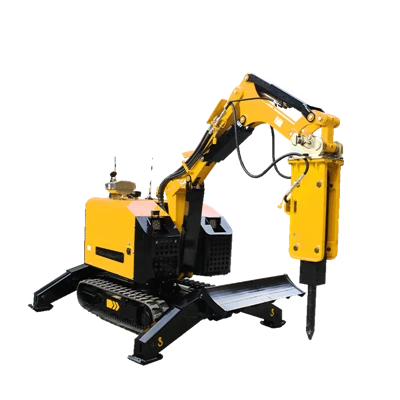
The ZJ300D Demolition Robot is a medium-sized intelligent remote-controlled demolition equipment with an operating weight of 4,350 kg. Powered by a 37 kW electric motor, this advanced demolition robot combines power performance with operational flexibility, making it widely applicable in hazardous environment operations.
Dredge Robotics
The ZJ600 Intelligent Sludge Removal Robot represents a major breakthrough in dredge robotics, delivering specialized operational equipment that integrates efficient dredging with intelligent detection. With a core dredging efficiency of 150 m³/h, this advanced dredge robotics solution provides precise answers to siltation problems in municipal and industrial scenarios.
Dredge Robot
The ZJ600 Dredging Robot is a highly efficient and intelligent underwater dredging device, specifically designed for sediment removal in rivers, lakes, reservoirs, and municipal pipe networks. This advanced dredge robot is equipped with remote control and autonomous navigation systems, enabling precise positioning and efficient operation without the need for on-site personnel.

Demolition Robot Specification
|
Model |
ZJ300D |
|
Drive Type |
Electric Motor Drive |
|
Power |
37 kW |
|
Operating Weight |
4,350 kg |
|
Track Width |
300 mm |
|
Equipment Dimensions |
4144 × 1200 × 1652 mm |
|
Control System |
Portable Wireless Remote Controller |
Advantages of Demolition Robot
They Come With Tremendous Power
Being a heavy-duty machine, demolition robots have many added advantages. One of the most evident is power. Although the robot's size is much more compact than its counterparts, its power is much greater. These tools are able to continue forward without interruption or breaks. They can significantly outperform excavators that are five to six times larger.
Remote-controlled Operations
Among demolition robots, you can find that there are a variety of types. One of the classes of demolition robots is remote-controlled demolition robots. The remote-controlled aspect of the robot provides an added control to its features. In addition to greater efficiency, they are safer than the manually operated options. Because operators can control them from outside the machine, the risks are lower. They are safe from harmful elements and unforeseen collapses.
The Three-Armed System
Most demolition robots are equipped with a three-armed system. On construction sites, some areas are compact and dense, making them hard to access. The three-armed system extends the range of reach of the robot. These robots are able to access anything in a 360-degree range. Previously inaccessible areas are now far more approachable. Additionally, the three arms provide better precision and accuracy for more exact work.
Heat Resistant
The evacuation and demolition of buildings takes a large amount of power. With this power comes a lot of heat. As the construction machinery generates this energy, the cylinders inside become hot. This is dangerous to the operator and the engine. Many demolition robots are heat-resistant. This is safer for the operator, the environment, and the cylinders. They keep every component safe and reduce the likelihood of overheating. This also extends the longevity of the demolition robot.

Demolition robot works by using remote-controlled, electrically powered machines equipped with specialized hydraulic attachments designed for breaking, crushing, drilling, and removing concrete and other structural materials. These compact robots are operated at a safe distance by trained technicians, allowing for precise, controlled demolition in confined, hazardous, or sensitive environments.
Because the equipment is lightweight, maneuverable, and low-emission, it can be safely used indoors without compromising air quality or structural stability while also allowing for faster project timelines and improved safety. Demolition robot is a smart and efficient alternative to traditional demolition methods.
Types of Demolition Robot
Compact Robots:
Ideal for indoor demolition, these robots can navigate narrow doorways and corridors, perfect for projects in residential buildings, offices, and schools.
Mid-Size Robots:
Offering a balance of power and agility, these robots are suitable for medium-scale projects, including commercial renovations and selective demolition tasks.
Heavy-Duty Robots:
For large-scale industrial demolition projects, these powerful machines can handle more rigid materials and more demanding environments.
Dredge Robotics Specification
|
Robot Dimensions |
1350 × 600 × 600 mm |
|
Dredging Width |
600 mm |
|
Travel Speed |
3–17 m/min |
|
Operation Method |
Remote Control |
|
Slurry Pump Diameter |
116 mm |
|
Slurry Pump Head |
30 m |
|
Cable Reel System |
Electric Drive (or Manual) |
|
Maximum Particle Diameter |
40 mm |
|
Sewage Pipe Length |
50 m |
|
Special Underwater Pipeline |
50 m |
|
Working Efficiency |
150 m³/h |
|
Suitable Pipe Diameter |
>0.6 m |
Application of Demolition Robot
Historical Building Renovations:
Where preserving architectural integrity is crucial, demolition robots can precisely perform delicate demolition work.
Industrial Plant Dismantling:
Demolition robots allow for safe and efficient demolition in environments with potential hazards or heavy machinery.
Urban Redevelopment:
In densely populated areas, demolition robots offer a low-noise, low-disruption solution, minimizing the impact on the surrounding community.
Improve production efficiency:
The robot can work continuously without human fatigue and environmental restrictions, which greatly improves the efficiency of sludge cleaning.
Reduce operating costs:
Reduce labor input, reduce labor costs, and safety risk costs.
Ensure personnel safety:
Remote control operation avoids direct contact between operators and sludge, reducing the risk of occupational diseases and safety accidents.
Improve cleaning quality:
Intelligent navigation and precise positioning functions ensure the thoroughness of cleaning and improve the cleaning quality.
Environmental protection and energy saving:
Accurately control the cleaning process to reduce unnecessary energy consumption and secondary pollution.
The Basic Principle Of Dredge Robotics
Deployment: The dredge robotics is lowered into the water body or tank, either manually or via automated systems. It is positioned at the designated sludge accumulation zone.
Navigation: Using onboard sensors and GPS, the dredge robotics navigates the environment, avoiding obstacles and mapping the area for efficient coverage.
Sludge Dislodging: The dredge robotics activates its mechanical tools—such as scrapers or brushes—to loosen the sludge from surfaces.
Extraction: Suction devices or conveyors then collect the dislodged sludge, transferring it into onboard or external containers.
Transport & Disposal: The dredge robotics transports the collected sludge to designated disposal or processing points, either autonomously or via remote control.
Return & Recharge: After completing its task, the dredge robotics returns to its docking station for maintenance, recharging, or data upload.
Application Fields of Dredge Robotics
Industrial wastewater treatment: In the wastewater treatment pools of industrial enterprises such as chemical plants and paper mills, the dredge robotics can efficiently clean the deposited sludge and ensure the normal operation of the wastewater treatment system. After a chemical plant introduced the robot, the cleaning cycle of the wastewater treatment pool was shortened from once a month to once a quarter, effectively reducing maintenance costs.
Urban river dredging: With the advancement of urban environmental governance, river dredging is becoming increasingly important. In a certain urban river dredging project, the V was used to complete the dredging task that previously took three months to complete in just one month, and the water quality of the river was significantly improved.
Aquaculture: In aquaculture sites such as fish ponds and shrimp ponds, silt accumulation will affect the water quality and the growth of aquatic products. Using a dredge robotics to regularly clean sludge can create a good environment for aquaculture and improve the output and quality of aquatic products.
Video
FAQ