


In the field of water environment governance, amphibious dredging robots are gradually becoming powerful assistants in dredging work due to their unique advantages. The efficient operation of these robots depends on their well - designed structure. The following will introduce its main components in detail.
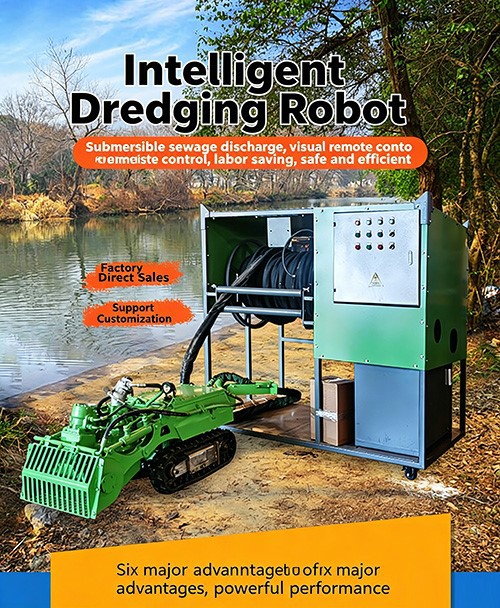
I. Power System
The power system is the "heart" of the amphibious dredging robot, providing energy support for all its functions. It usually consists of high - performance lithium - ion battery packs or fuel engines. Lithium - ion battery packs are clean, environmentally friendly, and produce low noise, making them suitable for water areas with high environmental requirements, such as urban inland rivers and landscape lakes. Their energy density is constantly increasing, enabling the robot to meet the needs of long - term dredging operations. Fuel engines, on the other hand, can provide more powerful power output, which is suitable for large rivers, ports, and other areas with a large amount of sediment and harsh working environments, ensuring that the robot can still operate stably under complex working conditions.
II. Movement and Steering Mechanisms
1. Land Movement Mechanisms
To adapt to land travel, the robot is generally equipped with a crawler - type or wheel - type chassis. The crawler - type chassis has a large contact area with the ground and low pressure, allowing it to travel stably on soft ground or in areas with large terrain undulations, and it is less likely to slip or get stuck. The wheel - type chassis, on the other hand, has a higher driving speed and mobility, making it convenient to quickly move to the work site on flat land. In addition, some advanced robots also have the function of adjustable chassis height to cope with different road conditions.
2. Water Propulsion Mechanisms
When operating on the water surface, the robot relies on propellers or water - jet thrusters to move forward, backward, and turn. Propellers have a high propulsion efficiency and can provide stable power for the robot, enabling it to move quickly in open water areas. Water - jet thrusters have better mobility and maneuverability, especially suitable for working in narrow rivers or areas that require frequent turning. At the same time, the robot is usually equipped with multiple propulsion devices. By precisely controlling the rotation speed and direction of each thruster, flexible water - based control can be achieved.
III. Dredging Operation Mechanisms
1. Manipulator and Dredging Tools
The dredging robot is equipped with a flexible manipulator that can move in multiple angles and degrees of freedom, enabling it to accurately position the areas that need dredging. Various dredging tools can be replaced at the end of the manipulator according to different dredging requirements. For example, a suction head is used to suck loose sediment; a crushing rake is used to break up hard sediment clumps for subsequent suction; and a grab bucket can pick up large - volume garbage and debris. With the cooperation of the manipulator, these dredging tools can efficiently complete various dredging tasks.
2. Suction and Discharge System
The suction and discharge system is the core part of the dredging operation. After the dredging tool stirs the sediment, strong suction sucks the sediment through the suction pipe. After passing through a filtering device for preliminary separation to remove large debris, the mud - water mixture is transported to the storage tank. When the storage tank is full, the robot can transport the sediment to the designated location and discharge it through the discharge pipe. Some robots are also equipped with a dewatering device to dewater the sediment before discharge, reducing the transportation volume and its impact on the environment.
IV. Sensing and Control Systems
1. Sensors
The robot is equipped with a variety of sensors to perceive the surrounding environment. Sonar sensors are used to detect underwater topography, sediment thickness, and the location of obstacles, providing accurate underwater information for dredging operations. LiDAR sensors can perceive the distance and shape of surrounding objects in real - time in both water and land environments, helping the robot with autonomous navigation and obstacle avoidance. Visual sensors use image recognition technology to identify the characteristics and targets of the dredging area, assisting the robot in precisely operating the dredging tools. In addition, water quality sensors are used to monitor water quality in real - time to ensure that the dredging process does not cause secondary pollution to the environment.
2. Control System
The control system is like the "brain" of the robot. It receives and processes information from various sensors, and according to preset programs and algorithms, it precisely controls the robot's movement, steering, dredging operations, and other actions. Operators can issue commands to the robot through a wireless remote control or a remote monitoring platform. At the same time, the control system also has an autonomous operation mode, which can automatically adjust the operation strategy according to environmental changes to achieve efficient and intelligent dredging work.
V. Auxiliary Systems
1. Protection System
Due to the complex working environment of amphibious dredging robots, they need to have good protection performance. Their outer shells are made of high - strength and corrosion - resistant materials, which can resist the erosion of water, sediment, chemical substances, etc. Electrical equipment and key components are waterproof, dust - proof, and moisture - proof, ensuring the long - term stable operation of the robot in harsh environments.
2. Communication System
The communication system keeps real - time contact between the robot and the operator. Through wireless communication technology, the operator can obtain real - time information such as the robot's position, working status, and sensor data, and remotely control the robot's various operations. In some large - scale dredging projects, satellite communication can also be used to achieve remote monitoring and control, ensuring that the robot can work normally in remote areas or areas with weak signals.
Through the coordinated operation of these structural components, amphibious dredging robots can achieve efficient and intelligent dredging operations in different water and land environments, providing strong technical support for water environment governance. With the continuous progress of science and technology, their structures and functions will continue to be optimized, playing a greater role in future environmental protection.


