


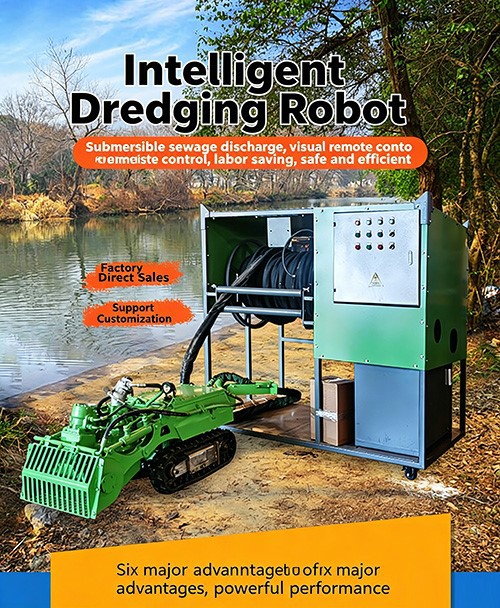
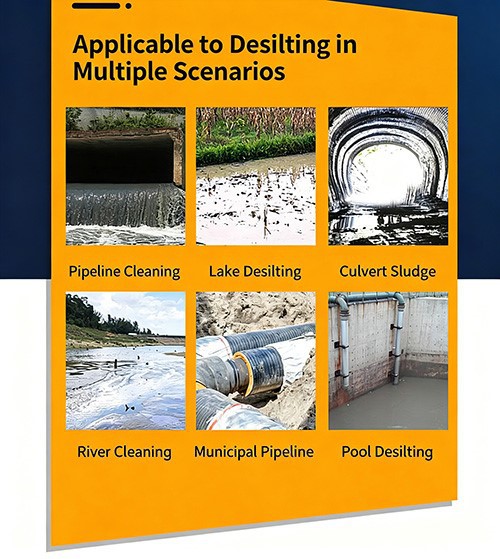
In urban drainage systems, rivers, and various water facilities, sediment accumulation is a common and challenging problem. Traditional dredging methods are not only inefficient but may also have a certain impact on the environment. With the advancement of technology, intelligent dredging robots have emerged, bringing new solutions to dredging work. Now, let's take a detailed look at the working principle of intelligent dredging robots.
1. Sensing System
Intelligent dredging robots are equipped with a variety of advanced sensors, which endow them with keen "senses" to perceive the surrounding environment.
Sonar Sensors: Sonar sensors are like the "underwater eyes" of the robot. By emitting and receiving ultrasonic waves, sonar can detect underwater topography, sediment thickness, and the location of obstacles. It can quickly and accurately map the three - dimensional map of the dredging area, helping the robot plan the dredging route and avoid colliding with underwater pipelines, bridge piers, and other obstacles. For example, in the complex urban drainage pipeline network, sonar sensors can detect bends, diameter changes, and blockages in the pipeline in advance, guiding the robot to move forward safely and efficiently.
LiDAR Sensors: In open - water areas above the water surface or in relatively wide water environments, LiDAR sensors play an important role. It determines the distance and shape of objects by emitting laser beams and measuring the time of reflected light. During dredging operations, LiDAR can perceive the surrounding environment in real - time, identify the boundaries of the shore, floating objects on the water, and other information, providing accurate data support for the robot's autonomous navigation and dredging operations. For instance, when dredging a lake, LiDAR can help the robot accurately define the dredging scope and avoid affecting the surrounding ecology beyond the work area.
Water Quality Sensors: Water quality sensors are like the "nose" of the robot, used to monitor various water quality indicators in real - time, such as pH value, dissolved oxygen content, and heavy metal concentration. Through water quality monitoring, on the one hand, we can understand the impact of dredging work on water quality to ensure that the dredging process does not cause secondary pollution; on the other hand, we can adjust the dredging strategy according to changes in water quality. For example, in areas with severe pollution, increase the dredging intensity or adopt special dredging methods.
2. Navigation and Positioning System
To accurately reach the designated dredging location in complex water environments and operate according to the 预定 route, intelligent dredging robots need a precise navigation and positioning system.
Global Positioning System (GPS): In open water areas, GPS can provide high - precision position information for the robot, enabling it to determine its position in the geographical coordinate system. By comparing with the pre - set dredging route, the robot can adjust its traveling direction in real - time to ensure that it follows the planned path for dredging work. However, in indoor drainage pipes or underwater areas with severe signal blockage, the GPS signal will be affected.
Inertial Navigation System (INS): To make up for the shortcomings of GPS in special environments, the inertial navigation system plays an important role. INS calculates the position, speed, and attitude changes of the robot by measuring its acceleration and angular velocity using Newtonian mechanics principles. Even in the absence of satellite signals, INS can enable the robot to continuously maintain an accurate perception of its position and direction, ensuring the continuity and accuracy of dredging operations. For example, when traversing long - distance underground drainage pipes, INS can be integrated with other sensor data to achieve precise navigation of the robot.
Visual Navigation: Intelligent dredging robots are also equipped with high - definition cameras to achieve navigation through visual recognition technology. The camera takes images of the surrounding environment, and the robot uses image recognition algorithms to analyze these images, identify specific markers, boundary lines, and other information, thereby determining its position and traveling direction. Visual navigation can provide more detailed and accurate navigation information near complex underwater structures or in areas with obvious visual features, complementing other navigation methods and improving the robot's navigation accuracy and adaptability.
3. Dredging Execution System
Based on perception and positioning, the dredging execution system of the intelligent dredging robot is responsible for completing the actual dredging work.
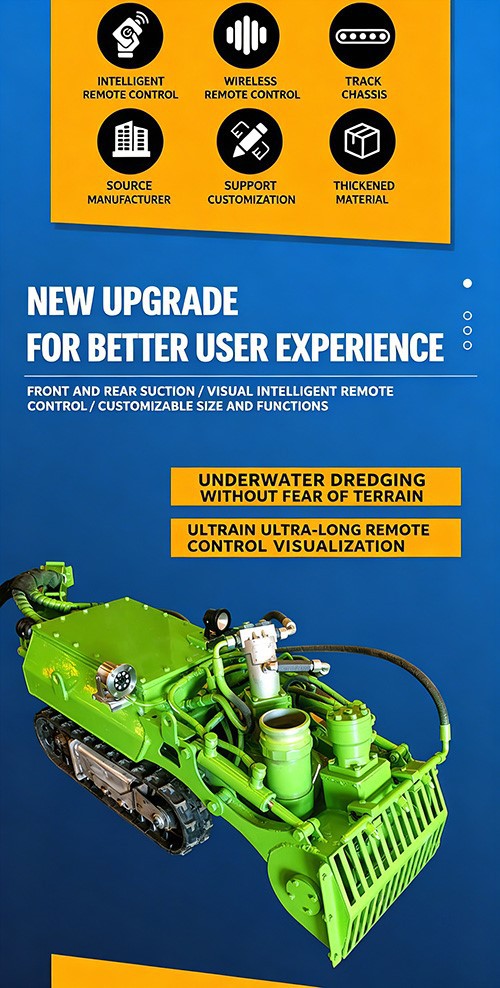
Manipulator and Dredging Tools: The robot is usually equipped with a flexible manipulator, and various dredging tools can be replaced at the end of the manipulator according to different dredging needs. For example, when removing hard sediment clumps, a dredging head with powerful crushing teeth will be used. Through the swinging and rotation of the manipulator, the clumps are broken and agitated; for relatively loose sediment, a suction nozzle is used to suck the sediment into the conveying pipeline with strong suction. The movement of the manipulator is driven by high - precision motors and control systems, which can achieve accurate positioning and operation, ensuring the efficient completion of dredging work.
Suction and Discharge System: The suction and discharge system is one of the core parts of the dredging robot. When the dredging tool stirs or breaks the sediment, the suction nozzle quickly sucks in the sediment. During the suction process, the strong suction can ensure that the sediment is collected quickly and effectively, while avoiding the spread of sediment in the water causing secondary pollution. The sucked sediment is transported through the pipeline to the filtering device inside the robot. After preliminary filtration, the water is discharged, and the remaining sediment is stored in a special storage tank. When the storage tank is full, the robot will transport the sediment to the designated discharge location for treatment according to the pre - set program.
Propulsion System: In order to move freely in the water, the intelligent dredging robot is equipped with an efficient propulsion system. Common propulsion methods include propeller propulsion and water - jet propulsion. Propeller propulsion has a high propulsion efficiency and is suitable for fast movement in open water areas; water - jet propulsion has better maneuverability and controllability and performs well in narrow rivers or complex pipeline environments. Through precise control of the propulsion system, the robot can perform various actions such as forward movement, backward movement, and turning, flexibly adjusting the dredging position and angle to adapt to different dredging conditions.
4. Control System and Data Analysis
The control system of the intelligent dredging robot is like its "brain", responsible for coordinating the work of various systems and analyzing and processing the collected data.
Central Control System: The central control system is the core hub of the robot. It receives information from various sensors, analyzes and judges the data according to preset algorithms and programs, and then sends instructions to the navigation system, dredging execution system, etc., to achieve the autonomous operation of the robot. For example, when the sonar sensor detects an obstacle ahead, the central control system will immediately adjust the navigation system, plan a new path, and at the same time control the dredging execution system to pause or adjust the working state to avoid collision.
Data Analysis and Intelligent Decision - making: The robot continuously collects a large amount of data during operation, including sediment thickness, water quality changes, dredging efficiency, etc. Through in - depth analysis of these data, the robot can make intelligent decisions. For example, according to the thickness and nature of sediment in different areas, automatically adjust the working parameters of the dredging tool, such as crushing force, suction force, etc., to achieve the best dredging effect; through long - term analysis of water quality data, predict the impact of dredging work on the ecological environment and adjust the dredging strategy in a timely manner to achieve environmentally friendly dredging. At the same time, the data analysis results can be fed back to the operator, providing reference and optimization suggestions for subsequent dredging work.

In conclusion, intelligent dredging robots obtain environmental information through the sensing system, move precisely with the help of the navigation and positioning system, complete dredging operations using the dredging execution system, and achieve intelligent operation and management relying on the control system and data analysis. This highly integrated working principle enables intelligent dredging robots to complete dredging tasks efficiently, accurately, and environmentally friendly in various complex water environments, playing an important role in the smooth operation of urban drainage systems and the improvement of river ecological environments.


