


When operating wheeled excavators in the vast Gobi regions of Central Asia, they face extremely harsh environmental challenges. Understanding the parts of wheeled excavators that are most likely to be damaged in such environments is crucial for proactive maintenance and prevention.

1. Tires
The terrain in the Gobi of Central Asia is complex, with sharp rocks and rough sand and gravel everywhere. The tires of wheeled excavators roll frequently in this environment and are highly likely to be cut, punctured by sharp objects, resulting in air leakage or even tire blowouts. Moreover, the Gobi region has a huge temperature difference between day and night. The high temperature during the day makes the tire rubber soft, while the low temperature at night makes it brittle, accelerating tire aging and cracking, and greatly shortening the tire's service life.
2. Air Filters
The Gobi region is plagued by sandstorms, with a large amount of dust suspended in the air. When a wheeled excavator is operating, the engine needs to inhale a large amount of air for combustion. However, if too much dust enters the engine with the air, it will exacerbate the wear of components such as the cylinder and piston, seriously affecting engine performance. Although wheeled excavators are equipped with air filters, in such a harsh dusty environment, the filters are extremely prone to clogging, resulting in poor air intake, a decrease in engine power, and even preventing the engine from operating normally.
3. Radiators
High temperatures are one of the prominent features of the Gobi region. Wheeled excavators generate a large amount of heat during long - term operation and require radiators to dissipate heat in a timely manner to maintain the normal operating temperature of components such as the engine. However, the dust in the Gobi is likely to adhere to the surface of the radiator, reducing its heat dissipation efficiency. Once the radiator fails to dissipate heat properly, the engine will overheat, which may lead to serious malfunctions such as cylinder scoring and bearing burnout, significantly increasing maintenance costs and downtime.
4. Hydraulic Systems
The hydraulic system of a wheeled excavator plays a key role in the accuracy and efficiency of operations. But in the Gobi environment, dust particles may invade the hydraulic system and contaminate the hydraulic oil. These impurities will exacerbate the wear of precision components such as hydraulic pumps, cylinders, and control valves, resulting in hydraulic oil leakage. Consequently, the pressure of the hydraulic system becomes unstable, affecting the accuracy and smoothness of the excavator's digging, lifting, and other movements.
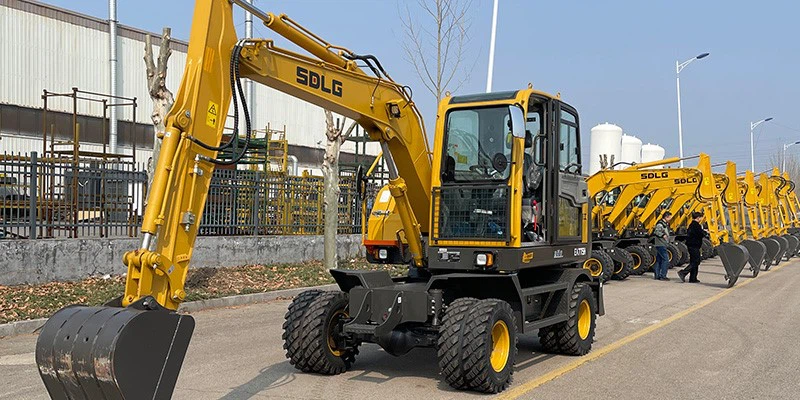
When using wheeled excavators in the Gobi regions of Central Asia, it is essential to develop a comprehensive maintenance plan for these vulnerable parts, regularly inspect and replace relevant components to ensure that the wheeled excavator always maintains a good working state and can complete tasks efficiently.


